Over the last few years, Tantra has become extremely accessible. Books, podcasts, YouTube discussions, and online forums have opened up teachings that were once preserved within lineages and traditional gurukuls. In many ways, this is a beautiful development. It shows that people across the world are searching for deeper meaning and are willing to explore the spiritual sciences that emerged from the Indian tradition.
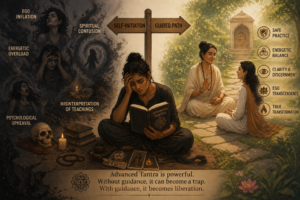
However, through my own work with students over the years, I have also seen another side of this trend. Many sincere seekers are now attempting to self-initiate into advanced tantric practices simply by reading about them or watching videos online.
The intention behind this is often genuine. People feel drawn to the power and depth of Tantra and want to experience it directly. But having worked with hundreds of students and practitioners, I have repeatedly observed that advanced tantric practices require a level of preparation and guidance that is often underestimated.
This is not because Tantra is mysterious or meant to be secretive. It is because Tantra works very directly with the human energy system, the subconscious mind, and deep karmic patterns. When approached without structure, the same practices that are meant to liberate can sometimes create confusion or imbalance.
Quick Read – How to Choose a Das Mahavidya Teacher: Lineage, Ethics, Consent, and Red Flags
Tantra Is Not Just Philosophy — It Is an Energetic Science
One of the biggest misunderstandings about Tantra today is that it is treated as a philosophy that can simply be read about and practiced immediately.
In reality, Tantra is closer to an energetic science.
The practices involve working with:
- mantra (sacred sound formulas)
- breath and pranic movement
- visualization and concentration
- subtle body awareness
- deity consciousness and archetypal energies
When practiced correctly, these techniques can shift the practitioner’s inner state very rapidly. That is precisely why traditional systems introduced them gradually.
Over the years, I have seen students come to my classes after trying practices on their own from books or online sources. Some of them are enthusiastic but confused. Others feel frustrated because they have been practicing something for months without understanding whether they are doing it correctly.
The problem is rarely their sincerity. The problem is usually the absence of a proper framework.
Suggested Read – Tantra, Bhakti, and Mahavidya: How These Paths Meet (and Differ) for a New Seeker
The Role of Initiation in Traditional Tantra
In traditional Tantra, initiation — or diksha — was never meant to be a ceremonial formality.
It served several important purposes.
First, it ensured that the student understood the practice correctly. Many tantric methods look deceptively simple when written down, but they carry layers of instruction that are usually transmitted verbally.
Second, initiation helped determine readiness. Not every practice is meant for every stage of a seeker’s journey. In traditional systems, students first developed stability through foundational disciplines such as breath awareness, meditation, and mental concentration.
Third, initiation created a relationship of guidance. Spiritual practices often bring up internal shifts — emotional, psychological, or energetic. Having someone experienced to interpret these changes makes a significant difference.
In other words, initiation historically functioned as a method of alignment — aligning the seeker’s readiness with the intensity of the practice.
What I Have Seen Among Students Attempting Self-Initiation
From my own experience teaching spiritual practices, there are several patterns that appear again and again when people attempt advanced Tantra entirely on their own.
1. Misinterpreting Techniques
Many tantric practices are written in concise, symbolic language. Without context, it is easy to misunderstand them.
A mantra, for instance, is not simply a phrase to repeat. Its impact depends on pronunciation, rhythm, breath, mental focus, and intention. When even one of these elements is missing, the practice can lose its effectiveness.
Students often come with questions like, “I have been chanting this mantra for six months but I don’t feel any change.” When we examine the practice more closely, we often discover that the structure of the practice itself was incomplete.
2. Attempting Advanced Practices Too Early
Another pattern I frequently see is people trying to jump directly into powerful practices — Kundalini techniques, intense deity sadhanas, or complex rituals — without first building mental stability and energetic balance.
In spiritual work, enthusiasm is important, but preparation is equally important.
Just as in physical training, the body cannot suddenly lift a heavy weight without conditioning. In the same way, the subtle system needs gradual strengthening.
3. Lack of Feedback
Spiritual practice often produces subtle shifts in perception and emotion. Without guidance, practitioners may not know how to interpret these changes.
Some people dismiss meaningful progress because they do not recognize it. Others assume that every internal sensation is a spiritual breakthrough.
A teacher’s role here is not to control the experience but simply to help interpret it with clarity and groundedness.
4. Fragmented Spiritual Practice
In today’s digital age, many seekers collect techniques from multiple traditions — a little yoga, a little Tantra, some breathwork, some energy practices from different systems.
While each of these methods can have value individually, combining them randomly can create an incoherent practice structure.
Traditionally, practitioners stayed with a structured path for a period of time because consistency allows the mind and energy system to deepen gradually.
Quick Read – Safety Guidelines for Das Mahavidya — A Teacher Speaks to a Seeker
Guidance Is Not About Control
It is important to clarify something here. Guidance in Tantra is not about creating dependency on a teacher.
In fact, the purpose of spiritual practice is to develop inner clarity and autonomy.
A good teacher does not replace your intuition. Instead, they help refine it. They provide direction in the early stages so that the practitioner can eventually develop their own stability and discernment.
In my own work with students, I always remind them that the goal is not to follow someone blindly. The goal is to develop enough inner awareness that your own spiritual intelligence becomes active.
Curiosity Is Beautiful — But Discipline Is Essential
I deeply appreciate the curiosity that people bring to spiritual exploration today. The willingness to learn and experiment is a positive sign of an evolving consciousness.
But Tantra has always balanced curiosity with discipline and responsibility.
Reading about Tantra can inspire you. Listening to teachings can motivate you. But when it comes to deeper energetic practices, structure and guidance protect the integrity of the path.
Tantra is one of the most profound spiritual sciences to emerge from the Indian tradition. It is not meant to be feared, but it also should not be treated casually.
Through years of teaching and working with students, I have come to appreciate something very simple:
Powerful practices transform us most effectively when they are approached with sincerity, patience, and the right guidance.
Self-study can open the door.
But true tantric practice unfolds most safely and deeply when learning, experience, and guidance move together.

Dr. Manmeet Kumar is a Spiritual Coach who founded Soul Miracles in 2016. She uses her gifts of being a psychic and a medium to enable others to transform their inner core.