It is often believed that spiritual practice is a deeply personal journey — something one undertakes alone, in silence, with a diya, a mantra, and one’s own thoughts. And while solitude does have its sacred place, many seekers quietly discover that walking the inner path entirely alone can sometimes feel confusing, inconsistent, and even isolating.
There are moments when one wonders why motivation fades, why discipline becomes difficult to sustain, or why spiritual experiences feel intense but unsupported. At such times, it becomes important to remember that the ancient spiritual traditions of this land were never built solely on solitary seeking. They were built on shared practice, guided circles, and collective invocation.
Even in the earliest Gurukul systems, students did not pursue knowledge in isolation. They learned together, chanted together, practiced together, and evolved within a shared energetic field. The presence of fellow seekers created discipline, continuity, and an environment where understanding deepened naturally. Spiritual knowledge was not just transmitted through texts but through collective vibration.
Solo practice, of course, remains essential. Sitting alone with a mantra, journaling after meditation, or lighting a diya in quiet reflection creates a direct and intimate connection with the Divine. Personal sadhana allows for emotional release, introspection, and individual communion with the Devi. Many profound realisations occur in these solitary moments.
Yet the solo path also has its limitations. Without a shared field of support, the mind can wander. Doubts may arise without resolution. Motivation may fluctuate. At times, one may even feel lost or disconnected, unsure whether what is being experienced is part of growth or simply mental fatigue. Spiritual energy, when held alone, can sometimes feel overwhelming or scattered.
This is where the power of collective practice becomes deeply transformative.
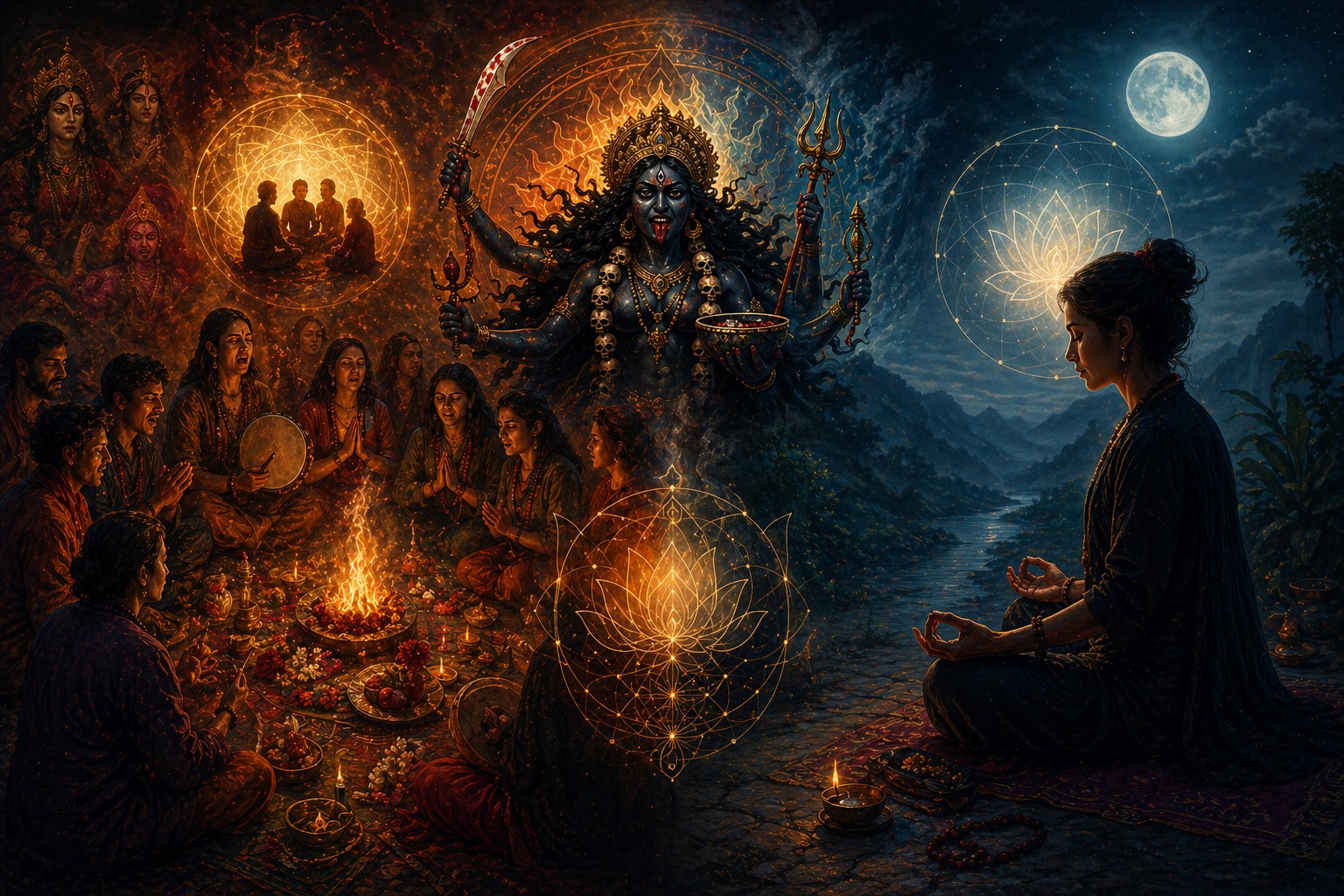
When individuals gather with a shared intention — especially within women’s circles or Mahavidya-focused groups — a different energetic field begins to form. Collective chanting amplifies vibration in a way solitary chanting cannot. The resonance of many voices reciting a mantra together creates a protective and elevating field of energy. One person’s devotion strengthens another’s focus. One person’s clarity illuminates another’s confusion. The Devi’s presence begins to feel not only personal but collective.
7 Myths About Das Mahavidya Sadhana — Why They Existed & What They Mean Today
There is also an emotional integration that occurs in group spaces. When seekers come together, they realise they are not alone in their struggles or transformations. One person may be navigating grief, another uncertainty, another inner awakening. When these experiences are shared in a respectful and sacred space, they create a web of understanding and support. The journey begins to feel less isolating and more anchored.
Women’s spiritual circles carry a particularly potent energy. It has long been observed that when women gather with sincerity and intention, the Divine Feminine rises naturally within that space. Collective chanting by women creates a powerful field of nurturing yet fierce energy — a field where emotional healing, intuitive clarity, and spiritual strength unfold organically. Such circles become containers of safety, growth, and deep inner movement.
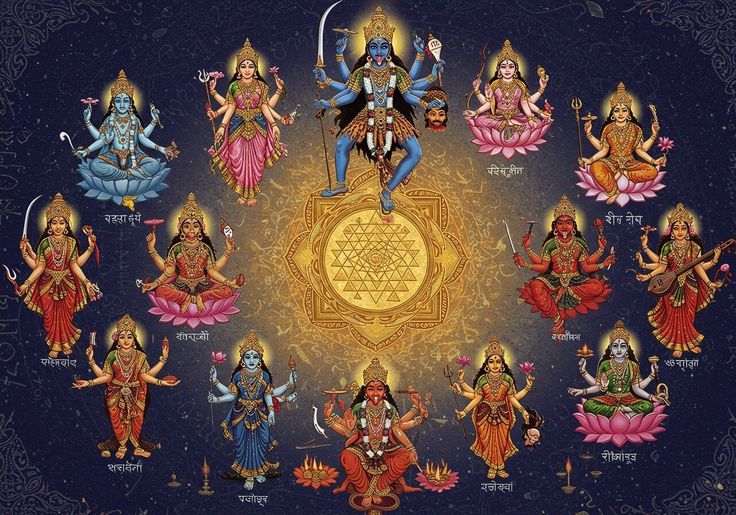
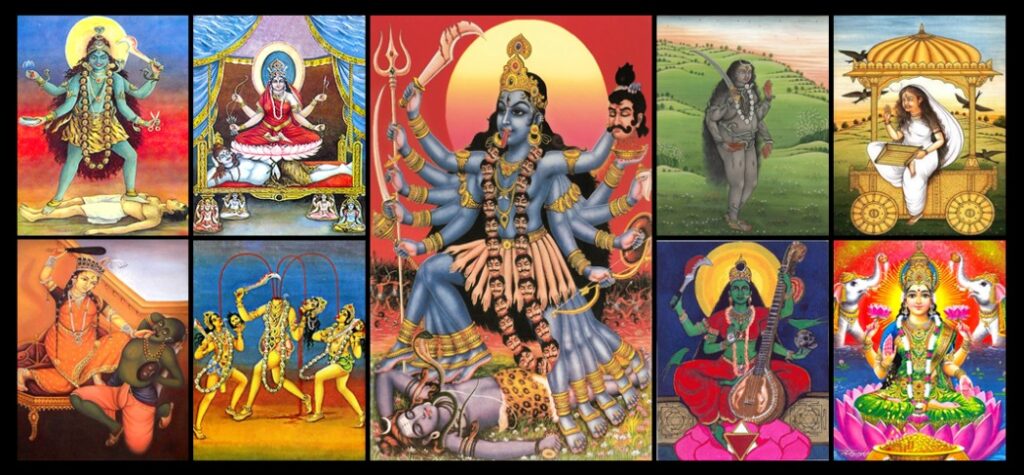
There is also a deeper symbolic truth here. The Mahavidyas themselves are not a single isolated form of the Divine Feminine. They are a collective — a sacred cluster of ten cosmic feminine intelligences that together represent the full spectrum of spiritual evolution. Kali transforms, Tara guides, Tripura Sundari harmonises, Bhuvaneshwari expands, Bhairavi disciplines, Dhumavati empties, Bagalamukhi protects, Matangi expresses, Kamalatmika blesses with abundance — each one a distinct force, yet all part of a unified mandala of Shakti.
None of the Mahavidyas function in isolation. Their energies complement, balance, and strengthen one another. Together they form a complete field of divine feminine consciousness. In many ways, this sacred clustering reflects the importance of collective practice among seekers. Just as the Mahavidyas exist as a circle of interwoven powers rather than a solitary force, practitioners too benefit from moving within a circle of shared intention and growth.
Safety Guidelines for Das Mahavidya — A Teacher Speaks to a Seeker
When a group gathers to invoke these energies together, it mirrors the very structure of the Mahavidya tradition itself. Each participant resonates with a different aspect of the Divine Feminine, and when they come together, these aspects begin to harmonise and strengthen. The group becomes a living mandala — a human reflection of the cosmic feminine circle. In such a space, transformation does not occur only at an individual level but within the collective field itself.
Collective chanting, shared rituals, and guided discussions create a sense of grounded progression. They help maintain discipline when motivation weakens. They provide reassurance when experiences feel intense. They allow insights to be integrated rather than scattered. Most importantly, they create a stable container within which the powerful energies of the Mahavidyas can be approached safely and respectfully.
This does not diminish the importance of personal practice. Solo sadhana remains the foundation of inner connection. However, when combined with group practice, it becomes more consistent, more supported, and more integrated. One returns to personal meditation with renewed clarity and strength after experiencing the collective field.
The Mahavidya path is not a casual or surface-level journey. It works deeply on emotional patterns, ancestral imprints, and karmic layers. Walking such a path entirely alone can sometimes feel overwhelming. Within a collective, however, the journey becomes steadier and more expansive. There is encouragement when discipline wavers, guidance when confusion arises, and shared strength when transformation feels intense.
Ultimately, spiritual growth flourishes through a balance of solitude and community. Solo practice nurtures the intimate relationship with the Devi, while group practice strengthens the protective and expansive field around that relationship. Together, they create a complete and grounded path.
There is a quiet but profound reassurance in knowing that one is not walking alone — that others are chanting, learning, and evolving alongside. In such circles, the Divine Feminine does not merely descend upon individuals; she rises through the collective, shaping a shared field of wisdom, strength, and transformation.

Dr. Manmeet Kumar is a Spiritual Coach who founded Soul Miracles in 2016. She uses her gifts of being a psychic and a medium to enable others to transform their inner core.