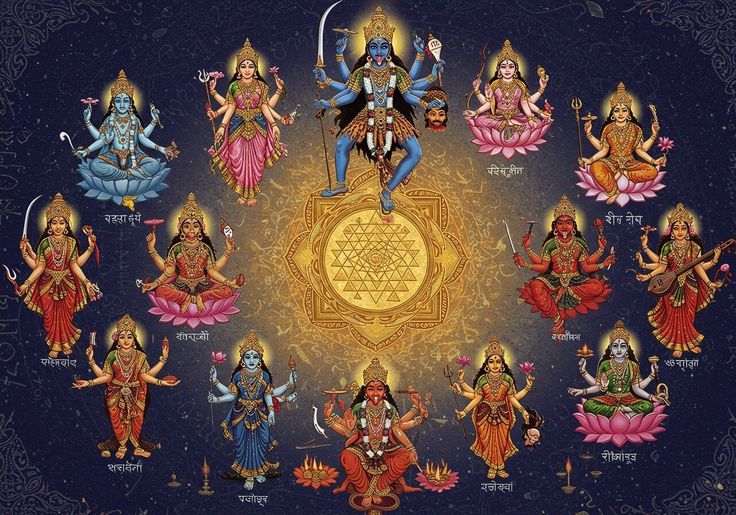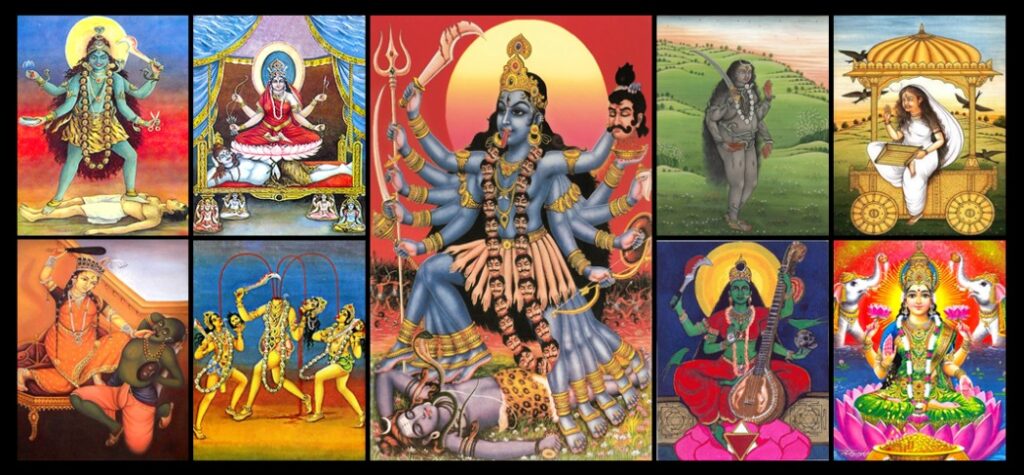
A beginner-friendly guide to the language of the Mahavidyas
When you begin walking this path, some words sound mysterious.
But once you understand them, the entire journey becomes easier, clearer, and more grounding.
Use this glossary as your first companion on the Mahavidya path.
1. Mahavidya
Meaning: The ten Great Wisdom Goddesses.
What it means for you: Ten different energies that awaken different strengths in your life.
Example:
If you are unable to end a toxic relationship → Kali rises.
If you are overwhelmed by fear → Tara steps in.
If you are stuck in confusion → Tripura Sundari brings clarity.
2. Ugra
Meaning: Fierce, intense, sharp.
Not “scary,” but non-negotiable truth.
Example:
When you finally decide: “I can’t lie to myself anymore.”
That moment is Ugra Shakti.
3. Shakti
Meaning: Your inner power and life-force.
Mahavidyas awaken this so you stop living weak or disconnected.
Example:
The day you speak your truth without shaking → your Shakti rose.
4. Sadhana
Meaning: A committed inner practice that transforms you.
Not casual. Not decorative.
Example:
Showing up every day for 15 minutes with honesty —
that is Sadhana.
5. Upasana
Meaning: Gentle worship.
Soft devotion without deep inner work.
Example:
Lighting a lamp, chanting for peace, reading a prayer — that is Upasana.
Mahavidya work goes deeper.
6. Kriya
Meaning: An inner energetic action — breath, visualisation, mantra.
Used to shift patterns.
Example:
Breathing through the solar plexus when anger rises —
that is a Kriya.
7. Mantra
Meaning: A vibrational code.
Not music — a frequency.
Example:
When you chant “Kreem” for Kali, you tune yourself into courage.
8. Beej Mantra
Meaning: The seed sound of a deity.
The purest, strongest vibration.
Example:
“Dhoom” for Dhumavati burns illusions and old attachments.
9. Diksha
Meaning: Transmission from teacher to student.
The Guru opens the door for you.
Example:
You suddenly feel calm or clear during a teaching —
that shift is Diksha.
10. Guru-Parampara
Meaning: A lineage of teachers.
Energy flows through lived experience, not Google.
Example:
Your teacher has learnt from someone who learnt from someone —
like a spiritual river that carries wisdom.
11. Shmashan
Meaning: Cremation ground.
Symbol of ego death, not physical death.
Example:
The day you realise “This old identity is gone,”
that inner collapse is your shmashan.
Your home can become your shmashan during a breakup, job loss, or major change.
12. Maya
Meaning: Illusion.
Not that the world is fake — but that your fears, stories, and assumptions are not the full truth.
Example:
Believing “I am not good enough” — this is Maya.
Mahavidyas break it.
13. Kleshas
Meaning: Inner emotional obstacles.
Example:
Anger you can’t control, fear of abandonment, attachment to someone who hurts you —
these are Kleshas.
14. Antahkarana
Meaning: Inner instrument — mind, ego, memory, intuition.
Example:
When you react without thinking — ego dominates.
When you pause and choose truth — intuition dominates.
Mahavidyas reorganise the antahkarana.
15. Bhairavi Tattva
Meaning: Discipline, presence, and inner fire.
Example:
When you show up even on days you don’t feel inspired —
that is Bhairavi Tattva.
Suggested Watch:
16. Swaroopa
Meaning: The symbolic or energetic form of the Goddess.
Example:
Kali’s sword = cutting illusions.
Tara’s blue colour = protection and healing.
Dhumavati’s smoke = endings and karmic exhaustion.
17. Vritti
Meaning: Mental/emotional waves.
Example:
Overthinking at night.
Irritation.
Jealousy.
Fear loops.
These are Vrittis that sadhana dissolves.
18. Kala
Meaning: Time, cycles, endings.
Example:
When a phase of life ends suddenly —
Kala is at work.
Mahavidyas help you move through these cycles consciously.
19. Adhyatmika / Adhibhautika / Adhidaivika
Meaning: Three kinds of suffering.
Example:
Self-created suffering → Adhyatmika
(“I overthink everything.”)
People-created suffering → Adhibhautika
(“My relationships drain me.”)
Fate-created suffering → Adhidaivika
(job loss, sudden illness)
Mahavidyas support all three.
20. Tattva
Meaning: Elemental principle.
Example:
Kali = Time
Tara = Protection
Bagalamukhi = Silence
Matangi = Speech
Kamala = Abundance
These tattvas shape different aspects of your life.
21. Mudra
Meaning: Hand gestures that channel energy.
Example:
Jnana Mudra during meditation calms the mind.
22. Prarabdha Karma
Meaning: The karma you are living out right now.
Example:
Recurring heartbreaks or patterns you didn’t consciously create —
these come from Prarabdha.
Mahavidyas help you move through it with strength rather than fear.
23. Shadow Work
Meaning: Facing the parts of yourself you don’t want to face.
Example:
Realising:
“I am clingy because I fear abandonment.”
“I get angry because I don’t feel heard.”
This is shadow work.
24. Devi Tattva
Meaning: Feminine principle — intuition, truth, boundaries.
Example:
When you stop apologising for your needs → Devi Tattva awakened.
25. Darshan
Meaning: An inner moment of recognition or awakening.
Example:
While meditating, you suddenly understand why a pattern keeps repeating —
this is Darshan.
26. Riddhi–Siddhi
Meaning: Natural blessings that arise from purity and alignment — not the goal.
Example:
Sudden clarity, confidence, opportunities, intuition, or healing.
27. Bhava
Meaning: Your inner emotional state while doing sadhana.
Example:
Even if your posture is imperfect, if your heart is sincere — your bhava is right.
28. Aavaran
Meaning: Layers of conditioning that cover your true Self.
Example:
Childhood wounds, limiting beliefs, body shame, people-pleasing — all are aavaran.
One by one, Mahavidyas remove them.
29. Sankalpa
Meaning: A soul-level intention.
Example:
“I want to stop repeating this pattern.”
“I want to choose myself now.”
When this decision comes from deep within, it becomes Sankalpa.
30. Shaktipath
Meaning: Descent of energy or grace.
Example:
During a practice, you suddenly feel heat, tears, peace, or stillness —
that is Shaktipath.
If these words feel new, don’t worry.
Every sadhak begins exactly where you are—curious, unsure, and slightly overwhelmed.
What matters is not how much you know, but how open you are to learning.
The Mahavidyas teach through lived experience, not vocabulary.
Walk slowly, stay sincere, and allow the Devi to meet you in her own way.
Your understanding will deepen with every step.

Dr. Manmeet Kumar is a Spiritual Coach who founded Soul Miracles in 2016. She uses her gifts of being a psychic and a medium to enable others to transform their inner core.